

Perfect squats for mass and strength! If you’re not squatting, you’re not really training. You’re playing. Perhaps hoping to add an inch or two to your arms by doing a bunch of upper-body exercises. But the fact is you’re not going to make any appreciable gains unless you incorporate a serious squatting routine into your overall program.
Perfect Squats – Train For Mass And Strength
You have to do perfect squats for mass and strength. This means full squats done correctly. It alkso means heavy weight. All muscular development starts with some form of strength training. Without establishing a solid strength base, your muscles will not grow to any significant degree. That means you will not have any appreciable definition or shape. A prevalent training misconception is that you can grow by teasing a variety of muscles. This suggests using a wide range of exercises without bothering to use heavy weights. Teasing the muscles can be effective for older men. Also for younger ones who aren’t really trying to add size to their physiques. But it’s a big mistake for individuals who are trying to pile on muscle to their upper body, back and legs.
Likewise, all strength development begins in the center of the body: the hips and legs. You’ll never be any stronger than this area of your body. Period. This means you must squat. Leg presses are certainly beneficial. So are various machines. Yet no other exercise even compares to the squat for building power in the hips and legs.
The Squatting Power Of John Grimek
This is nothing new in bodybuilding. All the greats of the sport emphasized the full squat, and some of them handled remarkable poundages. Talk about perfect squats for mass and strength! I recently visited with the great John Grimek. He related that only six years ago, while in London, he used more than 600 pounds in the squat. There was a time when bodybuilders put competitive weightlifters to shame at the squat rack. Many would come to the York Barbell Club in the 1960s and destroy the Olympic lifters. Bill St. John could perform 10 reps with 500 pounds almost effortlessly. Val Vasilef, Vein Weaver and Dennis Tinerino were equally strong.
Part of the reason for their prowess in the full squat was that they also competed in Olympic weightlifting meets. But once the athletic points were eliminated from bodybuilding shows, many began avoiding the squat rack in favor of more timid leg movements.
Perfect Squats For Mass And Strength
The current trend in bodybuilding is light weights for high reps. It’s also partial squats in place of the full-range movement. This seems to be in direct contrast to those super strongmen. Why is this? It’s certainly not because the lighter weights or partial movements are more productive. They aren’t. It’s because it’s easier to do a quarter squat than a full one. It’s much easier not to have to strain under a loaded barbell.
The Cardinal Rule Of Strength Training
Whenever you do any exercise in an easier manner, that exercise becomes less effective. I’m not talking about technique. I’m talking about effort. In order for squats to be productive, they have to be worked hard and with heavy weights. That;s why this article is called “Perfect Squats For Mass And Strength”. If the final few reps of the final set on a heavy day don’t make you see the White Buffalo, you didn’t use enough weight. This may not sound like much fun, and it’s not, especially at first. But what is fun is to see your poundages climb and your body grow.
Arguments Against The Squat
I’m well aware of the arguments against the full squat. They make your glutes too big. They’re bad for your knees. Nonsense. Full squats certainly involve the glutes, but in no way do they work those muscles to a greater extent than the others. They are worked proportionately, which is desirable. Why would anyone want large quads and tiny glutes? Muscular glutes do not detract from a physique. On the contrary, they improve it. Mr. Olympia Sergio Oliva came from an Olympic weightlifting background, so he always did lots of deep squats. His lower body was fantastic and perfectly proportioned.
What about the potential for damaging your knees by doing full squats? It’s been proven over and over that full squats are actually less damaging to the knee joints than partial movements. The National Strength Coaches Association, which deals with athletes who engage in contact sports, has gone on record in favor of full squats. The reason is fairly simple. Whenever a person stops anywhere above the parallel position, the responsibility of stopping the resistance falls directly on the knees. But once the thighs go below parallel, even slightly, the stress transfers from the knees to the hips, adductors and leg biceps.
In many instances, individuals perform partial squats rather than full squats because their instructors don’t know how to teach the full movement correctly. So to hide their ignorance, they use one or more of the standard arguments against full squats. In truth, they are doing their students a disservice.
When taught correctly, full squats are one of the safest strength-training exercises. There are 10 times more injuries to the shoulders from doing bench presses than there are to the quads and back from doing squats. Squatting is also one of the easiest exercises for a beginner to learn, because it is a natural movement. Just watch small children. They squat perfectly. True, the movement might be a bit more difficult to perform correctly as a person grows older, but this is because of a loss of flexibility.
Perfect Squats For Mass And Strength – The Full Squat
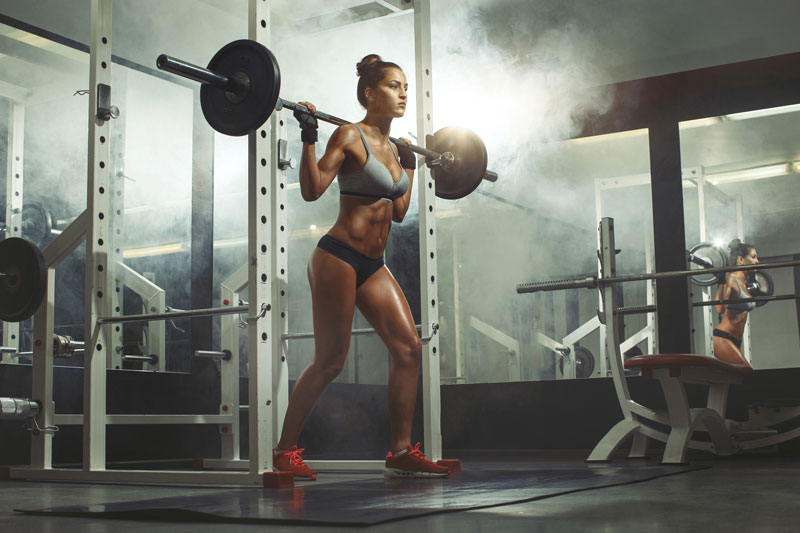
Positioning the bar properly on your back is quite important. The pressure of the barbell on the upper back causes more discomfort for beginners than any other aspect of the exercise. The problem is that the lifter, feeling the pain, tries to pull away from the bar. This places even more pressure on his spine. The trick is to shrug your traps upward to create a ledge on which to cushion the bar.
Your hand spacing should be fairly narrow. A closer hand spacing will help you stabilize the bar on your upper back. It’s critical to lock the bar tightly in place, because any movement will result in discomfort.
Proper foot positioning depends on your height. In the basic stance, your feet should be spaced slightly wider than your shoulders, while your toes should be turned slightly outward. Taller people usually find that a wider stance works well for them. Although a bit of experimentation will help you find the stance that best suits you. Just make sure you’re able to go below parallel without your heels coming off the floor. Is keeping them on the floor presents a major problem? Try placing a small plate or block under your heels at the beginning. But don’t use this aid for an extended period of time. Elevating your heels places your knees in a more vulnerable position. The tendency of your heels to come off the floor merely reflects a lack of flexibility in the rear portion of your lower legs. Performing squats will actually improve this flexibility.
The Squat Works Your Legs And Your Back
Before you start down with the weight, take a moment to tighten your entire back. The squat is as much a back exercise as it is a leg exercise. If you relax your back at all, the bar will not stay in the correct position throughout the entire movement. So pull your shoulder blades together and tense your lower-back muscles.
With the bar fixed tightly to your back in a controlled manner, squat until your thighs are just below the parallel position. (A mirror is a most useful training aid for this purpose.) You need not go to rock bottom, but breaking parallel is extremely important. Full squats not only protect your knees, but they are also essential for complete, proportionate muscle development. Once you break parallel, you involve your adductors and leg biceps to a much greater extent than you would if you merely did a partial rep. The advantages of this for a bodybuilder are obvious, but there is another, often overlooked, benefit. If you do only partial squats, you can handle heavy weight relatively quickly. Partial squats do hit the quads, but they neglect the adductors and leg biceps. The result is disproportionate development, which inevitably leads to problems down the road. Performing full squats guarantees balanced development among all the muscles of the hips and legs. This is what perfect squats for mass and strength are all about.
Once you reach this below-parallel position, drive the weight back upward, think of exploding into the bar with your back. The squat is really a strength feat, not a tame exercise. Certainly you can toy with lighter weights, but when the weight gets heavy, you have to be prepared to apply your full effort, and this is best accomplished by practicing it during every set.
A Few Squat Tips
Since everyone is built differently, form will vary from individual to individual. Some do better with an upright posture and a relatively wide stance. Others are better served by leaning forward slightly and adopting a narrower stance.
What about positioning your head while squatting: Should you look up or down? Neither. Your head should be allowed to “float” freely on the top of your spine. It’s all right to orient your head slightly up or down, but the angle should never be extreme.
Breathing is another important consideration for beginners. Take a breath before you start down with the bar, then hold that breath until you’ve passed the sticking point during the upward portion of the rep. Reset at the top, take one or two breaths, then descend again for the next rep. You don’t want to breathe during the exercise itself, this causes the muscles to relax ever so slightly and is not conducive to handling maximum poundages.
There are a few things you should never do when squatting. Never bounce off the bottom position. This is common sense: If you continually jam into the bottom of the movement, you’re going to irritate your knees, hips, back or all three.
Also, don’t allow your back to round too much. A little is okay, but if your heavy squats resemble good mornings, you’ve got a problem. If you find that your knees turn inward during squats, you most likely have comparatively weak adductors. To remedy this, get in some extra work on an adductor machine. If your gym doesn’t have that apparatus, do some squats using an extra wide stance and lighter weight (a Smith machine works well for these).
Perfect Squats For Mass And Strength – The Front Squat
Unfortunately, this exercise has all but disappeared from bodybuilding routines. At one time, however, it formed a primary part of every program. This is because in those days most bodybuilders were also competitive weightlifters. They did front squats to help them in the clean and jerk. The movement is most useful because it forces the lifter to go very low. This activates some new muscle development.
I believe that it’s important for anyone wanting to do front squats to learn to rack the bar firmly on his front delts. Don’t have it lie across his delts with crossed arms. The bar must be grasped firmly with both hands, elbows under the bar. While the crossed-arms method is certainly easier to use, it will never allow you to handle really heavy weights. Typically, a person lacks flexibility in the shoulder girdle when trying front squats for the first time. All it takes is some stretching movements to learn how to rack the bar correctly.
I like front squats because they force the lifter to stay upright. This makes them particularly useful for individuals who habitually lean too far forward when doing full squats. They’re also useful for those who have trouble going below parallel with full squats. Any attempt to shorten the range of motion of a front squat only makes it harder to complete.
I recommend performing sets of only three reps for front squats. No matter how firm the positioning, the bar will still slide forward a little on each rep, and it’s risky if it shifts too far forward. Better to perform extra sets of low reps and maintain perfect form.
Front squats do a nice job of developing the very front portion of the quads while working the hips, leg biceps and adductors as well.
Perfect Squats For Mass And Strength – The Smith Alternative
The Smith machine is a useful component of any overall squatting program. It’s particularly effective as part of a rehab regimen. This is because the movement is so controlled. It’s also useful for hitting some of the smaller muscle groups that are difficult to isolate with regular squats. What’s more, the quads can really be attacked by placing your feet out in front of the bar on the Smith and going extra deep on the downstroke. It would be impossible to duplicate this movement using regular squats. But the Smith machine should be used only as an adjunct to full squats. Never use it as a replacement for them. Keep in mind that with any type of machine, there is not nearly as much tendon and ligament involvement. There is always more with free-weight movements. These attachments are the true sources of strength.
So if you haven’t been squatting, it’s time to start. If you’ve been playing with light weights, start piling on the plates. Master perfect squats for mass and strength. Everything else will follow.