


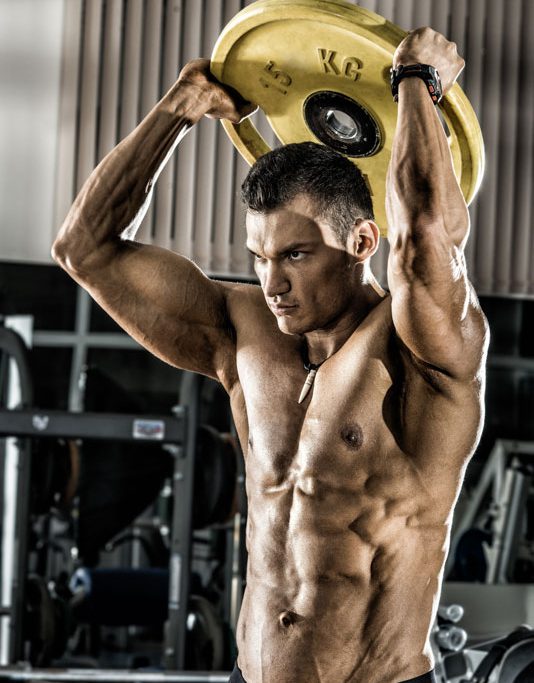
Behind The Neck Press – Muscles Involved
There are five major muscles involved in the behind-the-neck press. The reason is because separate movements occur in the shoulder girdle (scapula and clavicle), the shoulder joint (arm) and elbow joint (forearm). There has to be simultaneous actions in each of these areas. Otherwise, you would not be able to execute the exercise.
The muscles most involved in the shoulder girdle are the serratus anterior and the trapezius. The serratus anterior is a large muscle. It runs from the upper ribs at the side of the chest to the medial border of the scapula, or shoulder blade. In the back the serratus is covered by the scapula. In the front it is covered by the pectorals. However, it can be seen and felt directly below the armpit when you raise your arm against resistance.
Behind The Neck Press – The Traps
The trapezius is divided into four sections. Only the first and fourth sections are involved. These are located at the uppermost and lowermost portions of the upper back. The upper portion runs from the base of the skull to the upper outside edge of the scapula. The lower portion runs from the lower thoracic vertebrae to the inside upper edge of the scapula.
The Shoulder Joint
In the shoulder joint, the deltoid and the supraspinatus are the major muscles involved. The deltoid covers the outside of the shoulders. That’s what gives them their oval appearance. It is attached to the outside border and the top of the scapula at the upper end. At the lower end, it attached to the humerus, or upper arm bone. The supraspinatus runs from the top of the humerus to the inner supraspinous fossa. This small but powerful muscle is covered by the upper—middle half of the trapezius.
Behind The Neck Press – The Triceps
In the elbow joint the major muscle is the triceps brachii, which covers the entire back of the upper arm. The triceps is divided into three sections. These are known as the lateral, medial and long heads. The lateral head originates on the top of the humerus. Next, the medial head originates on the lower humerus. Finally, the long head originates on the scapula just below the shoulder joint. All three heads run into a common tendon. This inserts on the olecranon process of the uIna bone in the forearm.
Behind The Neck Press – Muscle Action
In the shoulder girdle the major actions are upward rotation and elevation of the scapula. The rotation occurs on an axis through the center of the scapula. In other words, when looking at the back, the top of the scapula turns in and down. The bottom of the scapula turns up and to the side. Also, the scapula and clavicle are also raised at the shoulder joints. However, this is not a major action. It involves the upper trapezius and levator muscles.
In the shoulder joint the action is abduction (the same action as in raising the upper arms to the sides). In the elbow joint the action is extension. This is where the arm straightens from a flexed position in the elbow.
Sports Uses
The behind the neck press can be a good exercise for athletes. It combines shoulder-girdle upward rotation, shoulder-joint abduction and elbow-joint extension. This action is used in all sports that require an overhead pushing or reaching action.
The actions of the behind the neck press are seen in weightlifting, gymnastics, acrobatics, hand balancing and other similar overhead type activities. All of these require pressing strength. They are also involved in all overhead-hitting actions. This includes the tennis serve and smash. Also, the ceiling shot and overhead kill in handball and racquetball. Finally, the overhead clear and smash in badminton and others.
The Behind The Neck Press And Bodybuilding
Bodybuilders need this exercise to build up the muscles on the sides of the ribs and on the upper and lower portions of the upper back. The development of the muscles on the sides of the ribs (serratus anterior) is especially noticeable. When well defined they show up as a series of short, thick separate sections because of their saw-tooth attachments to the ribs.
How To Execute The Behind The Neck Press
When first doing this exercise, execute the behind-the-neck press in a seated position. You should sit on an exercise bench. Grasp the bar with a palms-down (pronated) grip. Your hands should be 4-6 inches wider apart than your shoulders. The exact amount will depend on your flexibility. With this positioning your elbows will automatically be pointed to the sides and downward. The barbell should rest on your hands and upper trapezius.
With the bar in position, begin the behind the neck press by raising the bar at a slow to moderate speed. Raise until your elbows are fully extended. Lower slowly to the initial position and repeat. Keep your back straight, i.e.,in its normal position, and look forward during execution.
Comments
1)The behind the neck press is an excellent exercise for developing shoulder-joint flexibility and strength. In proper execution the anterior (front) deltoid is stretched more. This allows your elbows to move to the sides and hack. Your scapulae move toward the spine and almost touch one another. This movement maximally stretches the serratus anterior.
The prior stretching of these muscles allows for a more forceful contraction during the lift. This provides greater development of these muscles. Therefore, it is important that you use the right amount of weight. Use enough to allow you to go through the full range of motion. Yet, the exercise should not be easy. Challenge yourself.
2)When you lift maximal or near-maximal weights, use a double breathing cycle. Inhale before the lift, hold your breath during the press and forcefully exhale when the lift is completed. Hold the bar on locked arms, and breathe in again. Hold your breath as you slowly lower the bar. Then exhale when you reach the starting position.
Such a double breathing cycle stabilizes the chest. This way, the required actions of the behind the neck press in the shoulder girdle and shoulder joint can take place. In addition, it helps you to maintain a rigid midsection. This keeps you from bending your spine during execution and thus helps to prevent injury.
Comments Continued
3)More balance is required when you do the behind-the-neck press in a standing position. For more balance you must have greater overall strength in the legs. Also in the midsection, both abdominals and lower back. Although not directly involved in the exercise, the leg and midsection muscles must contract isometrically. This helps you hold the necessary standing position. They prevent you from hyperextending the spine or tilting to either side.
Finally, maintain balance when executing the behind-the-neck press while standing. Balance can be maintained by standing with your feet slightly wider than shoulder width. Also, try putting one foot slightly in front of the other.
4)The behind-the-neck press can also be executed on an exercise machine. However, on most machines the handles do not move in a straight line directly overhead. Instead, they move in an arc. Accordingly, you should slide the seat forward or back so that your hands remain relatively above your body. Do not move too far in front or behind. You will also have to adjust the height of the seat. You’ll want your hands in line with or slightly above the line of your shoulders in the starting position.